


The Octave Illusion was discovered by Deutsch in 1973, first reported at a meeting of the Acoustical Society of America (Deutsch 1974)1 and first published in Deutsch, Nature (1974)2.
Figure 1 shows the pattern that produces the Octave Illusion. Two tones that are spaced an octave apart are alternated repeatedly at a rate of four per second. The identical sequence is played over headphones to both ears simultaneously; however when the right ear receives the high tone the left ear receives the low tone; and vice versa. The tones are sine waves of constant amplitude, and follow each other without amplitude drops at the transitions. So in fact the listener is presented with a single, continuous two-tone chord, with the ear of input for each component switching repeatedly.
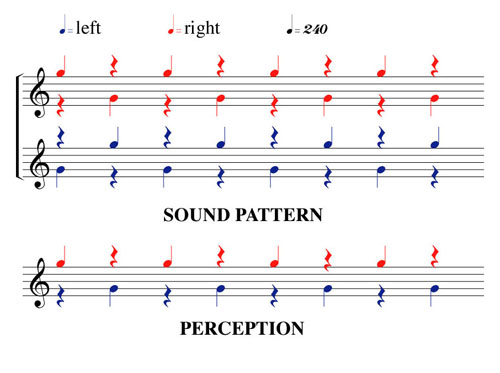
| Figure 1. The pattern that produces Deutsch’s Octave Illusion, and a way that it is often perceived when played through stereo headphones. The listener hears a high tone in the right ear that alternates with a low tone in the left ear. |
The Octave Illusion needs to be heard through stereo headphones. Make sure that the loudspeakers on your sound system are turned off, and that the left and right channels are balanced for loudness. Then readjust the settings on your amplifier so that the sounds, as heard through the headphones, are somewhat on the soft side.
Now listen to this pattern. If you hear a higher tone in one ear and a lower tone in the other ear, decide which ear is hearing the higher tone. Then reverse the earphone positions and listen to the pattern again. Decide again which ear is hearing the higher tone.
 Play Deutsch's Octave Illusion
Despite its simplicity, this pattern is almost never heard correctly, and instead produces a number of illusions. Many people hear a single tone that switches from ear to ear, while its pitch simultaneously shifts back and forth between high and low. So it seems as though one ear is receiving the pattern 'high tone - silence - high tone - silence' while at the same time the other ear is receiving the pattern 'silence - low tone - silence - low tone'. Even more strangely, when the earphone positions are reversed many people hear the same thing: The tone that had appeared in the right ear still appears in the right ear, and the tone that had appeared in the left ear still appears in the left ear. This produces the bizarre impression that reversing headphone positions causes the high tone to migrate from one earphone to the other, and causes the low tone to migrate in the opposite direction!
The Octave Illusion has another surprising property – right-handers and left-handers (considered as groups) tend to hear the pattern in different ways. Right-handers tend to hear the high tone on the right and the low tone on the left, regardless of how the earphones are positioned. Yet left-handers vary considerably in terms of where the high and low tones appear to be coming from. Moreover, the tendency to hear the high tone on the right and the low tone on the left is stronger among people with only right-handers in their family than among those with a left-handed parent or sibling3.
Other listeners experience quite different illusions. Some hear a single tone that switches from ear to ear, whose pitch remains the same or changes only slightly as the tone appears to change location. Yet others describe quite complex percepts. For example, some hear a high tone that switches from ear to ear, whose pitch shifts back and forth by a semitone, together with an intermittent low tone in one ear (Figure 2a). Other listeners hear a low tone that switches from ear to ear, together with an intermittent high tone in one ear (Figure 2b). Some listeners report that the pitches appear to change gradually as the sequence continues, while for yet others, the pattern appears to speed up and slow down in unpredictable ways. Some people say that the high and low tones sound as though produced by different instruments - for example, the high tone may sound like a flute and the low tone like a gong. Some listeners experience different illusions at different times, so that the pattern appears to be constantly changing. Left-handers are more likely than right-handers to hear changing patterns.4,5.
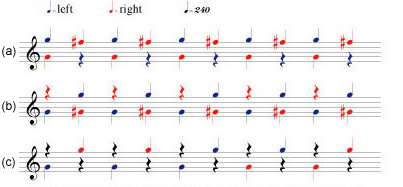
| Figure 2. Some other ways that Deutsch’s Octave Illusion is perceived. Some listeners hear a high tone that alternates from ear to ear with a slight change in pitch, together with an intermittent low tone in one ear, as in (a). Other listeners hear a low tone that alternates from ear to ear, together with an intermittent high tone in one ear, as in (b). Yet other listeners hear a high tone in one ear that alternates with a low tone in the other ear, but the high and low tones often appear to exchange locations, as in (c). |
A few people hear the illusion as a single high tone in one ear that alternates with a single low tone in the other ear; however the high and low tones appear periodically to reverse positions, as shown in Figure 2c. This percept is analogous to the reversal of ambiguous figures in vision. For example, the Necker cube, shown in Figure 4, is perceived as spontaneously changing its orientation – the back face periodically becomes the front one. Another example occurs in Escher’s ‘Regular division of the plane III’ shown in Figure 4. In the uppermost portion of this picture the black horsemen provide the figure and the white horsemen the ground. In the lowermost portion, the situation is reversed. However in the middle portion, there is a region of ambiguity in which one’s perception alternates between the two alternatives.
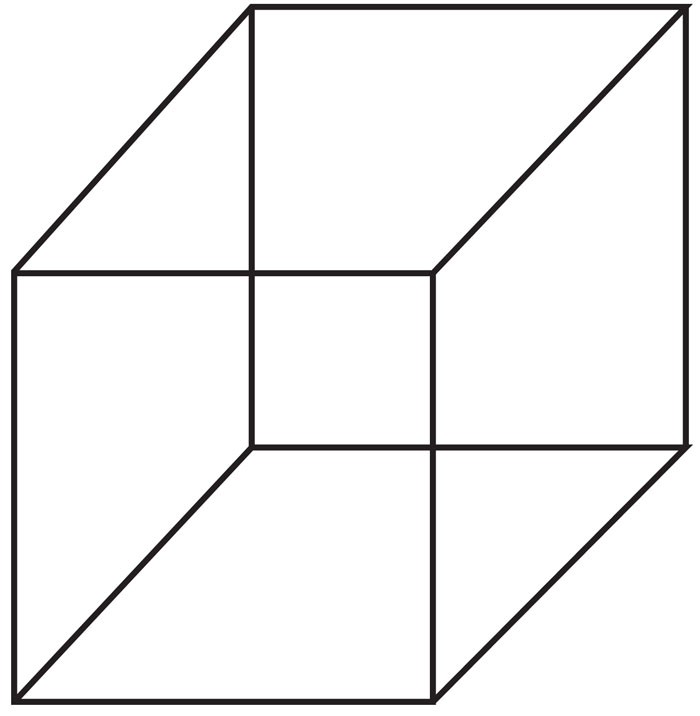
| Figure 3. The Necker cube. In viewing this figure, the back face of the cube periodically becomes the front one. This visual illusion is analogous to some percepts of the Octave Illusion, in which the high and low tones appear periodically to exchange locations. |
How can the octave illusion occur? In considering the percept most commonly obtained – that of a single high tone in one ear alternating with a single low tone in the other ear - I conjectured that it results from the combined operation of two separate decision mechanisms: one determines what pitch we hear, and the other determines where the tone appears to be coming from4. The model is shown in Figure 5. To determine the perceived pitches, the frequencies arriving at one ear are perceived, and those arriving at the other ear are suppressed from perception. However, each tone is heard as though arriving at the ear that receives the higher frequency, regardless of whether a pitch that corresponds to the higher or the lower frequency is perceived 4-6.
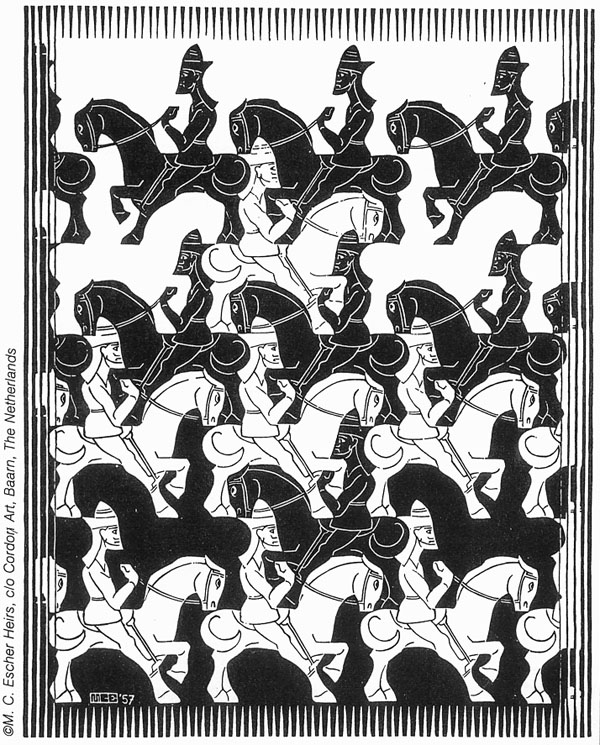
| Figure 4. “Regular Division of the Plane III” by M. C. Escher. In the center of this picture, sometimes the black horsemen provide the figure and the white horsemen the ground, but at other times the opposite perception occurs. |
Viewing this diagram, we can take a listener who perceives the pitches that are presented to his right ear. When the high tone is delivered to the right and the low tone to the left, this listener hears a high tone, because this is presented to his right ear. The listener also hears the tone as though arriving in his right ear, because this ear is receiving the higher frequency. However, when the low tone is delivered to the right ear and the high tone to the left, this listener now hears a low tone, because this is presented to his right ear, but he hears it as though arriving at his left ear instead, because this ear is receiving the higher frequency. This results in an illusory conjunction of pitch and location, so that the entire sequence is perceived as a high tone to the right, alternating with a low tone to the left.
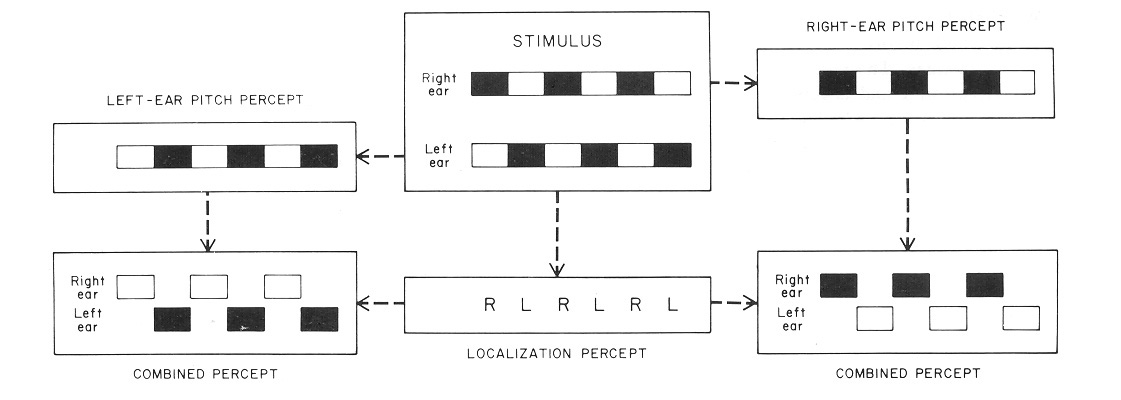
| Figure 5. Model showing how the output of two decision mechanisms, one determining perceived pitch, and the other determining perceived location, can combine to produce the Octave Illusion. The black boxes indicate high tones and the white boxes indicate low tones. |
We can see that, on this model, reversing the positions of the earphones would not alter the basic percept of a high tone to the right alternating with a low tone to the left. However, a listener who perceives the pitches that are presented to the left ear instead, holding the localization rule constant, would hear the same pattern as a high tone to the left alternating with a low tone to the right. Evidence for this model has been provided in both perceptual and brain scanning studies7. References 8 – 15 provide more information and discussion of this strange illusion.
References:
- Deutsch, D. An auditory illusion. Journal of the Acoustical Society of America, 1974, 55, s18-s19. [Web Link]
- Deutsch, D. An auditory illusion. Nature, 1974, 251, 307-309. [PDF Document]
- Deutsch, D. The octave illusion in relation to handedness and familial handedness background. Neuropsychologia, 1983, 21, 289-293. [PDF Document]
- Deutsch, D. Musical Illusions. Scientific American, 1975, 233, 92-104. [PDF Document]
- Deutsch, D. Illusions for stereo headphones. Audio Magazine, 1987, March, 36-48. [PDF Document]
- Deutsch, D. & Roll, P. L. Separate "what" and "where" decision mchanisms in processing a dichotic tonal sequence. Journal of Experimental Psychology: Human Perception and Performance, 1976, 2, 23-29. [PDF Document]
- Deutsch, D. Grouping mechanisms in music In D. Deutsch (Ed.). The psychology of music, 3rd Edition, 2013, 183-248, San Diego: Elsevier. [PDF Document]
- Deutsch, D. The octave illusion revisited again. Journal of Experimental Psychology: Human Perception and Performance, 2004, 30, 355-364. [PDF Document]
- Deutsch, D. Reply to Reconsidering evidence for the suppression model of the octave illusion, by C. D. Chambers, J. B. Mattingley, and S. A. Moss. Psychonomic Bulletin and Review, 2004, 11, 667-676. [PDF Document]
- Deutsch, D. Lateralization and sequential relationships in the octave illusion. Journal of the Acoustical Society of America, 1988, 83, 365-368. [PDF Document]
- Deutsch, D. Auditory illusions, handedness, and the spatial environment. Journal of the Audio Engineering Society, 1983, 31, 607-618. [PDF Document]
- Deutsch, D. The octave illusion and auditory perceptual integration. In Tobias, J. V., and Schubert, E. D. Hearing Research and Theory, Volume 1, 1981, 1, 99-142. New York: Academic Press. [PDF Document]
- Deutsch, D. Ear dominance and sequential interactions. Journal of the Acoustical Society of America, 1980, 67, 220-228, [PDF Document]
- Deutsch, D. The octave illusion and the what-where connection. In R. S. Nickerson (Ed.). Attention and Performance VIII, 1980, 575-594. [PDF Document]
- Deutsch, D. Lateralization by frequency for repeating sequences of dichotic 400-Hz and 800-Hz tones. Journal of the Acoustical Society of America, 1978, 63, 183-186. [PDF Document]
- Deutsch, D. Some musical illusions are discovered. Chapter 2 in Musical Illusions and Phantom Words: How Music and Speech Unlock Mysteries of the Brain, Oxford University Press. 2019.
- Deutsch, D. Some musical illusions are discovered. Chapter 2 in Musical Illusions and Phantom Words: How Music and Speech Unlock Mysteries of the Brain, Korean translation, Eidos Publishing Group, 2023
- Deutsch, D. Some musical illusions are discovered. Chapter 2 in Musical Illusions and Phantom Words: How Music and Speech Unlock Mysteries of the Brain, Chinese translation, Guangxi Normal University Press, Group Co, Ltd.., 2024.
- Deutsch, D. (Ed.). Grouping mechanisms in music. Chapter 6 in The Psychology of Music, 3rd Edition, San Diego: Elsevier, 2013.