


The Glissando Illusion was discovered and first published by Deutsch on the CD Musical Illusions and Paradoxes, 19951. As in other stereo illusions described in this section, this shows how a cue that generally helps us to perceive our environment correctly can instead lead to perceptions that are wildly wrong. It also shows that a simple sound pattern can be perceived by different people in strikingly different ways.
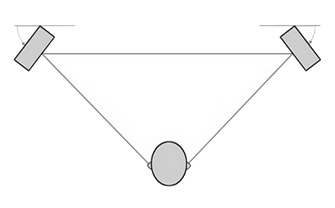
| Figure 1. Seating arrangement for experiencing Deutsch’s Glissando Illusion. The listener is seated in front of two loudspeakers, with one to the left and the other to the right. |
To experience the Glissando Illusion, you should be seated in front of two stereo loudspeakers, with one to your left and the other to your right, as in Figure 1. The effect is strongest when the room is somewhat reverberant, such as an auditorium. (Listening through headphones does not produce as good an illusion.)
The pattern that gives rise to the Glissando Illusion consists of two components: A synthesized oboe tone of constant pitch (the oboe tone), and a sine wave that repeatedly glides up and down in pitch - rather like a siren (the glissando). The two components are presented simultaneously through the two loudspeakers, and are constantly switching from speaker to speaker such that when the oboe tone is coming from the speaker on the right a portion of the glissando is coming from the speaker on the left; and vice versa. A fragment of this pattern is illustrated in Figure 2.
 Play Deutsch’s Glissando Illusion
This sound demonstration presents the Glissando Illusion as it was originally presented by Deutsch (1995). (In listening to this pattern, first set the sound level so that it is on the soft side, and make sure that the channels are balanced for loudness.) Notice that when only one channel is played - either the left or the right one - you correctly hear the oboe tone alternating with a portion of the glissando. However when both channels are played together, for most people the experience changes dramatically: The oboe tone is heard correctly as switching back and forth between the loudspeakers. However, the portions of the glissando appear to be joined together quite seamlessly, so that a single, continuous tone is heard that appears to be moving around in space in accordance with its pitch motion. Notice, also, that as the rate of switching between the oboe tone and the glissando speeds up and slows down, the apparent speed at which the glissando appears to move through space remains constant, and tied to its pitch motion.
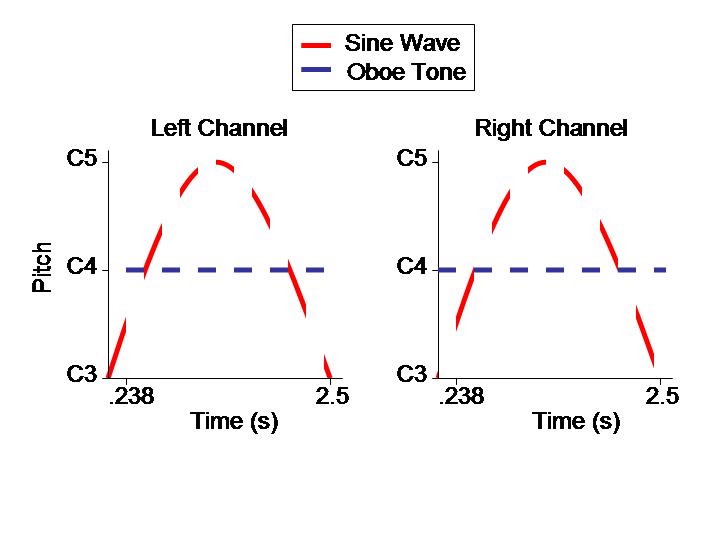
| Figure 2. Fragment of the pattern that gives rise to Deutsch’s Glissando Illusion, as it was presented in the experiment. |
My colleagues and I carried out a formal experiment to document perception of the Glissando Illusion in different handedness groups2, 3 . The oboe tone was constant at Middle C, and the sine wave glided up and down in pitch between the octave below Middle C and the C an octave above. The switching rate between the glissando and oboe tone was held constant at 238 ms, and the duration of one cycle of the glissando was held constant at 2.5 sec. We chose these parameters so that the spatial positions of the glissando when its pitch was highest and lowest would vary throughout the sequence.
Sixty-four listeners with normal hearing listened to this pattern. They were designated as 'right-handed' or as 'nonright-handed' depending on their responses to a handedness questionnaire. The listeners were tested individually, and were seated as in Figure 1. They listened to the pattern first facing the loudspeakers, and then facing the opposite direction. They reported verbally what they heard, and backed up their verbal descriptions with diagrams.
All the listeners correctly heard the oboe tone as switching back and forth between the loudspeakers. However, the way the glissando was perceived varied from one listener to another. Most right-handers heard it as moving from left to right as its pitch moved from low to high, and as moving from right to left as its pitch moved from high to low. This percept occurred regardless of whether the listener was facing the loudspeakers or facing the opposite direction. Other listeners heard the glissando move around in different ways; for example as moving from right to left as its pitch moved from low to high, or even moving between front and back. Left-handers were more likely than right-handers to hear different and varying patterns of spatial motion.
Many listeners also reported that as the pitch of the glissando moved from low to high it appeared to move upward in space, and as its pitch moved from high to low it appeared to move downward. The interaction between the apparent spatial motion along the left-right and the up-down dimensions caused many right-handers to perceive the glissando as tracing an elliptical path that was aligned diagonally between a point low and to the left when its pitch was lowest, and a point high and to the right when its pitch was highest. This illusory percept is illustrated in Figure 3, which reproduces the diagram drawn by one of the listeners.
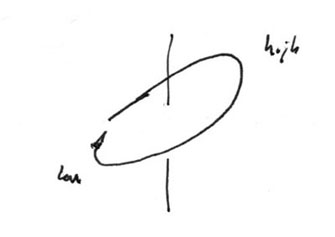
| Figure 3. Diagram drawn by a listener to illustrate his perception of the Glissando Illusion. |
Perhaps the most remarkable aspect of the Glissando Illusion is that, although the portions of the glissando are alternating abruptly between widely different spatial positions, it is perceived as though coming from a single source that moves slowly around in space in accordance with it pitch motion. This provides an instance of the brain making a plausible but incorrect 'best guess' about the signals it receives. In everyday life, when we hear a sound that changes slowly in pitch - such as a siren - it is much more likely to be coming from a single source which is either stationary or moving slowly in relation to us, rather than alternating rapidly between two widely separated sources. The brain therefore uses the cues of pitch proximity and pitch continuity between successive portions of the glissando to conclude that it is coming from a single source that is moving slowly through space. The illusion also provides an example of striking differences in sound perception that vary in association with the listener’s handedness, and so reflects differences in brain organization.
References
- Deutsch, D. Musical Illusions and Paradoxes, 1995, La Jolla: Philomel Records.
- Deutsch, D., Hamaoui, T., and Henthorn, T. The glissando illusion: A spatial illusory contour in hearing. Invited lay language paper, 149th meeting of the Acoustical Society of America, Vancouver, 2005.
- Deutsch, D., Hamaoui, K., and Henthorn, T. The Glissando Illusion and Handedness. Neuropsychologia, 2007, 45, 2981-2988, [PDF Document]
- Deutsch, D. (Ed.). Grouping mechanisms in music. Chapter 6 in The Psychology of Music, 3rd Edition, San Diego: Elsevier, 2013.
- Deutsch, D. Some musical illusions are discovered. Chapter 2 in Musical Illusions and Phantom Words: How Music and Speech Unlock Mysteries of the Brain, Oxford University Press. 2019.
- Deutsch, D. Musical Illusions and Phantom Words: Chapter 2 in How Music and Speech Unlock Mysteries of the Brain, Korean translation, Eidos Publishing Group , 2023.
- Deutsch, D. Musical Illusions and Phantom Words: Chapter 2, inHow Music and Speech Unlock Mysteries of the Brain, Chinese translation, Guangxi Normal University Press, Group Co, Ltd., 2024.
- Deutsch, D., Hamaoui, K., and Henthorn, T. The Glissando Illusion and Handedness. Neuropsychologia, 2007, 45, 2981-2988,