


When we listen to music, short-term memory plays an important role in determining what we hear. Without such memory, we would not be able to tell how the different tones in a phrase are related to each other. In a number of studies I showed that memory for the pitch of a tone is retained in a specialized memory system, which is organized in precise and orderly ways. Below are a few examples of these studies.
In one study I found a remarkable dissociation between tones and spoken words in memory1. (In this study, as in the others described here, all the tones were pure tones.) Suppose you play a tone, and then another tone which is either the same in pitch as the first, or differs by a semitone, most people find it very easy to decide whether the two tones are the same or different. This is true even when the tones are separated by a five-second delay, as in the examples played here. (In this figure, and in the figures that follow, the tones that are shown are not the same as those in the sound examples.)

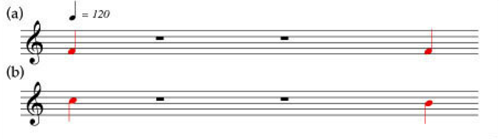
| Figure 1. Two examples of tones to be compared for pitch. Judge whether the test tones are the same or different. Here the second test tone follows the first after five seconds of silence, and the judgment is easy. In (a) the test tones are the same in pitch, and in (b) they are different. |
Suppose, now, that six extra tones are played during the interval between the test tones. This often makes comparing the test tones very difficult, even though listeners can ignore the extra tones, as in the examples shown here:
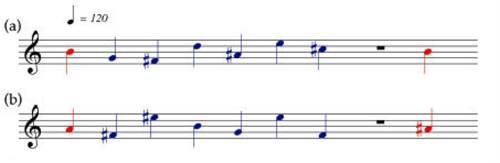
| Figure 2. Two examples of tones to be compared for pitch. Here the second test tone follows the first after a delay in which six extra tones are played. Judge whether the first and second test tones are the same or different, ignoring the extra tones. In (a) the test tones are the same in pitch, and in (b) they are different. The extra tones make the task of comparing the test tones much more difficult. |
Why should this be? One possibility is that we retain pitches in a specialized memory store, and that memory loss is caused by interference between pitches that are held in this store. If this were so, then presenting other types of material during the interval between the test tones should not interfere with memory for pitch in the same way.
In the next examples, two test tones are again played, but this time they are separated by an interval in which six spoken numbers are presented instead. Listen to the first test tone, ignore the spoken numbers, and then judge whether the second test tone is the same as the first, or different.
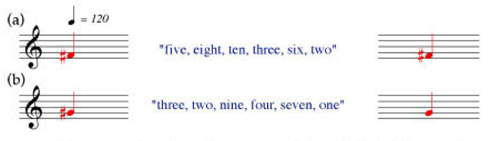
| Figure 3. Two more examples of tones to be compared for pitch. Here the second test tone follows the first after a delay during which six spoken numbers are presented. Judge whether the test tones are the same or different, ignoring the spoken numbers. In (a) the test tones are the same in pitch, and in (b) they are different. The intervening numbers produced almost no interference with the pitch memory judgments. |
Most people find the pitch memory judgment much easier when spoken numbers rather than tones are played during the interval between the test tones. This contrasts remarkably with the difficulty that is experienced when extra tones are played during this interval, even though the extra tones can be ignored. So we can conclude that the pitch of a tone is held in a specialized memory store, and that interference takes place between pitches inside this store. Other materials - such as spoken numbers - do not enter the store, so they produce much less interference with memory for pitch.
The CD ‘Phantom words, and other curiosities’ contains the sound patterns and instructions for carrying out a full experiment on this effect, together with the answers.
Further studies have shown that the system underlying memory for the pitch of a tone is organized in a remarkably systematic fashion. In one experiment, I placed a tone in the intervening sequence whose relationship to the first test tone varied in steps of 1/6 tone (that is, 1/3 of a semitone) up to a separation of two semitones (see Figure 4). I tested subjects who made very few errors in a baseline experiment, and found that as the distance between the first tone and this critical tone increased, the error rate also increased. Errors peaked at a separation of 2/3 tone between the first tone and the critical intervening tone, and then gradually returned to baseline2.
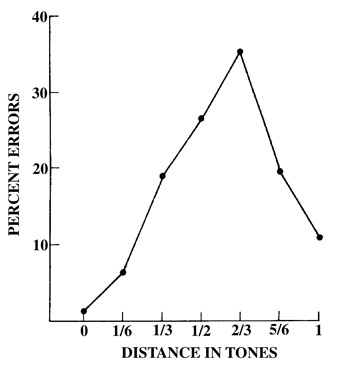
| Figure 4. Percentage of errors in pitch recognition, plotted as a function of the pitch separation between a critical intervening tone and the first test tone. The peak of errors occurred when the critical tone was 2/3 tone removed from the first test tone. (From Deutsch, D., Science, 1972.)2 |
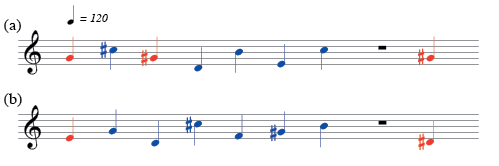
Another factor also has a strong influence on pitch memory judgments. Often when listeners can tell that a tone had occurred in a sequence, they are unable to tell when it had occurred. In one experiment 3, 4, listeners heard two test tones that were separated by an interval of five seconds during which six extra tones were played. As before, the test tones were either the same in pitch or they differed by a semitone, and the subjects judged whether the test tones were the same or different, ignoring the extra tones. When the test tones differed in pitch, the intervening sequence sometimes included a tone that was the same in pitch as the second test tone, as shown in Figure 5. For such patterns, listeners tended strongly to judge that the second test tone was the same as the first, even though it was different. In other words, listeners recognized that this tone had occurred in the sequence, but were uncertain when it had occurred, and so often assumed that it was the first test tone. The closer in time the inserted tone was to the first test tone, the greater the number of errors.
|
Figure 5. Two examples of tones to be compared, when these differ in pitch, and are separated by six extra tones. In (a), a tone of the same pitch as the second test tone is included in the intervening sequence. In sequences such as this, because there is loss of memory for when this tone had occurred, listeners sometimes assume that it had been the first test tone, and so mistakenly assume that the first and second test tones are the same in pitch. In (b), no such tone is included, and listeners make fewer errors. |
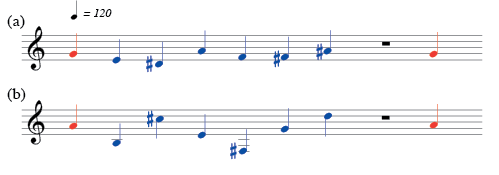
How well we remember tones in a sequence also depends on how close the different tones in the sequence are to each other. In one study5, listeners judged whether two tones were the same or different when these were separated by six extra tones. Listeners made considerably fewer errors when the pitches of the extra tones were close to each other, and so formed small melodic intervals, as in Figure 6(a), compared with when they were further apart and so formed large melodic intervals, as in Figure 6( b). In fact, the larger the sizes of the melodic intervals in the sequence, the larger the number of errors that were made. This experiment showed that a sequence of tones forms a framework of pitch relationships to which individual tones can be anchored in memory. The smaller the melodic intervals, the more effective is this framework, and so more accurate are pitch memory judgments.
|
Figure 6 Two examples of tones to be compared for pitch, when these are separated by a sequence of six extra tones. In sequences such as (a), the tones are close in pitch and form small melodic intervals. In sequences such as in (b), the tones are more distant from each other in pitch, and form larger melodic intervals. Listeners make fewer errors in sequences such as shown in (a) than in (b).
|
|
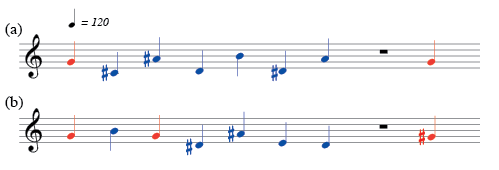
Figure 7 Two examples of tones to be compared for pitch, when these are separated by a sequence of six extra tones. Listeners make fewer errors when the first test tone is repeated in the intervening sequence, as in (b), than when this tone is not repeated, as in (a). Repeating the first test tone improves performance both when the test tones are the same in pitch and also when they are different. |
In further experiments6 I found that when listeners compared two tones that were separated by a sequence of extra tones, repeating the first test tone in the sequence improved performance. The advantage gained by repeating the first test tone occurred both when the test tones were the same in pitch and also when they were different. In other words, judgments in comparing test tones in sequences such as shown in Figure 7(b) where the first test tone is repeated, are better than in those such as in Figure 7 (a), where the first test tone is not repeated6. This has implications for memory for entire musical phrases, since we would expect the repeated tone to influence the way the listener organizes and remembers the entire phrase. Also considering the fact that phrases formed of small melodic intervals are well remembered, we can see that there is a considerable advantage to be gained from a musical system that has a limited number of ‘anchor tones’ that are well remembered through repetition, which are surrounded by ‘satellite tones’’ that are linked to the anchor tones by small melodic intervals. This type of pattern occurs in many musical cultures –including Western tonal music – and is likely to be well perceived and remembered7.
Another interesting finding about memory for pitch is that there are statistical differences in performance between right-handers and left-handers8, 9. Listeners judged whether test tones were the same or different in pitch when they were separated by a sequence of extra tones. Taken as a statistic, left-handers performed better than right-handers on this task, and the best performance was produced by lefthanders who were also ambidextrous. I conjectured that this advantage may be due to a tendency for duplication of storage of pitch information among lefthanders, but this remains to be investigated.
Further details and discussion of the characteristics of the system underlying short term memory for tones are found in References 10-21.
References
- Deutsch, D., Edelstein, M., Dooley, K., and Henthorn, T., and Lapidis, R. Absolute pitch is disrupted by a memory illusion. JASA, 2021, April, 149, 2829, [PDF Document]
- Deutsch, D. Tones and numbers: Specificity of interference in immediate memory. Science, 1970, 168, 1604-1605. [PDF Document]
- Deutsch, D. Mapping of interactions in the pitch memory store. Science, 1972, 175, 1020-1022. [PDF Document]
- Deutsch, D. Dislocation of tones in a musical sequence: a memory illusion. Nature, 1970, 226, 286. [PDF Document]
- Deutsch, D. Effect of repetition of standard and comparison tones on recognition memory for pitch. Journal of Experimental Psychology, 1972, 93, 156-162. [PDF Document]
- Deutsch, D. Delayed pitch comparisons and the principle of proximity. Perception & Psychophysics, 1978, 23, 227-230. [PDF Document]
- Deutsch, D. Facilitation by repetition in recognition memory for tonal pitch. Memory & Cognition, 1975, 3, 263-266. [PDF Document]
- Deutsch, D. The processing of pitch combinations In D. Deutsch (Ed.) The psychology of music, 3rd Edition, 2013, 249-325. San Diego: Elsevier. [PDF Document]
- Deutsch, D. Pitch memory: An advantage for the lefthanded. Science, 1978, 199, 559-560. [PDF Document]
- Deutsch, D. Handedness and memory for tonal pitch. In J. Herron (Ed.) Neuropsychology of Lefthandedness, 1980, 263-271. New York: Academic Press. [PDF Document]
- Deutsch, D. & Feroe, J. Disinhibition in pitch memory. Perception & Psychophysics, 1975, 17, 320-324. [PDF Document]
- Deutsch, D. The influence of melodic context on pitch recognition judgement. Perception and Psychophysics, 1982, 31, 407-410. [PDF Document]
- Deutsch, D. Interference in pitch memory as a function of ear of input. Quarterly Journal of Experimental Psychology, 1978, 30, 282-287. [PDF Document]
- Deutsch, D. Interactive effects in memory for harmonic intervals. Perception and Psychophysics, 1978, 24, 7-10, [PDF Document]
- Deutsch, D. Memory and attention to music. In M. Critchley and R. A. Henson (Eds.) Music and the Brain, 1977, 95-130. London: Heinemann Medical Books. [PDF Document]
- Deutsch, D. The organization of short term memory for a single acoustic attribute. In D. Deutsch and J. A. Deutsch (Eds.). Short Term Memory, 1975, 107-151. New York: Academic Press. [PDF Document]
- Deutsch, D. Auditory memory. Canadian Journal of Psychology, 1975, 29, 87-105. [PDF Document]
- Deutsch, D. Generality of interference by tonal stimuli in recognition memory for pitch. Quarterly Journal of Experimental Psychology, 1974, 26, 229-234.
- Deutsch, D. & Roll, P. L. Error patterns in delayed pitch comparisons as a function of relational context. Journal of Experimental Psychology, 1974, 103, 1027-1034. [PDF Document]
- Deutsch, D. Interference in memory between tones adjacent in the musical scale. Journal of Experimental Psychology, 1973, 100, 228-231, [PDF Document]
- Deutsch, D. Octave generalization of specific interference effects in memory for tonal pitch. Perception and Psychophysics, 1973, 13, 271-275, [PDF Document]
- Deutsch, D. Music and memory. Psychology Today, 1972, 8552, 87-89, 119.
- Deutsch, D. (Ed.). The processing of pitch combinations. Chapter 7 in The Psychology of Music, 3rd Edition, San Diego: Elsevier, 2013.